
External Affairs Minister S Jaishankar has met United States Defence Secretary Lloyd Austin and held a productive conversation with him on deepening bilateral defence cooperation, including in the co-production of defence articles, and exchanged perspectives on a variety of security issues.

The two PMs called upon all countries to work towards rooting out terrorist safe havens and infrastructure.
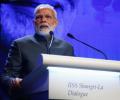
"No other relationship of India has as many layers as our relations with China. We are the world's two most populous countries and among the fastest growing major economies. Our cooperation is expanding," he said.

Asked whether the IAF can play a role in smashing terrorist training camps across the Line of Control in Jammu and Kashmir, he did not rule out such a possibility.

The PM was also seen chit-chatting with Japanese Prime Minister Shinzo Abe, Russian Prime Minister Dmitry Medvedev and Malaysian Prime Minister Najib Razak at the reception for the leaders who have arrived in Manila for the 31st ASEAN summit and related meetings.

Defence Minister Rajnath Singh on Wednesday conveyed to US Defence Secretary Lloyd Austin India's concerns over Washington's decision to provide sustenance package for Pakistan's F-16 fighter jet fleet.
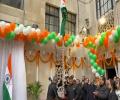
Leaders from around the world extended their greetings to India on its 76th Republic Day, emphasizing the importance of bilateral relations and expressing hope for a stronger future. The Indian diaspora across the globe celebrated the occasion with enthusiasm at Indian missions abroad, where the national tri-colour was unfurled, accompanied by cultural performances and patriotic fervour. The celebrations highlighted the strong bonds of friendship and cooperation between India and its global partners.

"We value our partnership with India, and we've been increasing it and doing a lot more, over time. They have the same security challenge, primary security challenger that we do, and it's real on their northern border," Admiral John Christopher Aquilino, commander of United States Indo-Pacific Command, told members of the House Armed Services Committee during a hearing on Indo-Pacific National Security Challenges.

The compulsion behind India and Japan to deepen security cooperation is in response to China's growing political and economic clout and its assertive behaviour in disputed areas. This has been the key driver for bringing both India and Japan closer in the domain of security cooperation, explains Dr Rajaram Panda.

Had India agreed to join the trade pact, Indian markets would have been flooded with cheap Chinese products.

The new framework of the ministerial dialogue was initiated in order to provide a forward-looking vision for the strategic partnership between the two countries.

The top diplomats of Quad nations on Friday denounced as "inadmissible" any use or threat of use of nuclear weapons in the Ukraine war and strongly opposed any "unilateral actions" that seek to change the status quo in the South and East China Seas, a region that has witnessed increasing Chinese military offensive.
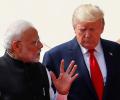
'While criticising India's high tariffs, Mr Trump stated he would impose reciprocal taxes on Indian products if re-elected.' 'However, since India's tariffs follow WTO rules, Mr Trump's actions would violate these rules,' Ajay Srivastava points out.

'Chinese dominance reduces India's influence in South and Southeast Asia and erodes its status globally.' 'For a country striving to create a multipolar Asia, it would be a serious setback,' says Brigadier S K Chatterji (retd).

One bill provides $60.8 billion for Ukraine, with over 80 percent of it for helping Kyiv amid its ongoing war with Russia, including replenishing supplies of US made weapons and ammunition.

'Everybody knows when I hear Indian music, I start dancing'

Modi said India Post and Japan Post would start a 'cool box service' for Japanese people living in India so they could order their favorite food from Japan.

China, the Ukraine crisis and Quad will dominate the discussions, observes Dr Rajaram Panda.
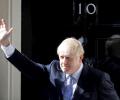
UK Prime Minister Boris Johnson was supposed to be the chief guest at Republic Day, but due to the surge in COVID-19 cases in the UK and the spread of a new strain, he cancelled his visit. Johnson is scheduled to visit India in April.

Ahead of the Quad summit on Friday, China said exchanges and cooperation between countries should contribute to mutual understanding rather than "targeting" a third party and refrain from "pursuing exclusive blocs".

The Quad also vowed to work towards a free, open and prosperous Indo-Pacific, a region that has seen increasing Chinese military muscle-flexing in the last few years.
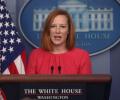
"AUKUS? What would it become? JAUKUS? JAIAUKUS?" Psaki said in lighter moments before giving answer to the question.

The 2 countries signed 15 agreements including one on defence cooperation after Prime Minister Narendra Modi held 'productive discussions' with President Joko Widodo.

He said that Canada recognises the impact that some of these measures may have and at the same time it's another reason why he placed such emphasis on the investigation that's taking place that they are able to move beyond credible intelligence to evidence, strong evidence of exactly what happened.

India and the United States have announced a groundbreaking 10-year defence partnership, paving the way for increased military cooperation and potential sales of F-35 stealth fighter jets. The agreement aims to bolster both countries' defence capabilities in the Indo-Pacific region, with plans for joint production of weapons and platforms. The move comes amid China's growing military presence in the region.

Modi will have a number of high-profile multilateral and bilateral meetings with global leaders including United States Vice President Mike Pence and Singapore premier Lee Hsein Loong.

The Pahalgam massacre highlights the evolution of terrorism into a multi-domain challenge. India's response must similarly evolve -- from tactical retaliation to comprehensive strategic deterrence. To establish a credible and sustained deterrent, India must also carry out continuous kinetic operations, both overt and covert, suggest Sakshit Raina and Rahul Mishra. To establish a credible and sustained deterrent, India must also carry out continuous kinetic operations, both overt and covert, suggest Sakshit Raina & Rahul Mishra.
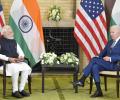
Biden praised India's Covid vaccination efforts.

The prime minister is likely to sign key agreements in various sectors with both the nations.
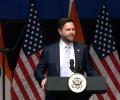
US Vice President JD Vance called on India to drop non-tariff barriers, give greater access to its markets and buy more American energy products and military hardware. Vance, in a speech in Jaipur, highlighted the need for a stronger US-India partnership for a prosperous and peaceful 21st century. He emphasized the importance of working together to address global challenges and praised Prime Minister Narendra Modi, describing him as a "special person." Vance also urged India to provide greater market access to American products and buy more defense platforms and energy from the US. He suggested that India consider dropping some of the non-tariff barriers for American access to the Indian market and highlighted the benefits of closer India-US defense collaboration, advocating for New Delhi to procure more military hardware from the US. He cited the example of American fifth-generation F-35s, arguing they would give the Indian Air Force the ability to defend its airspace and protect its people like never before. Vance also welcomed the Modi government's budget announcement to amend India's civil nuclear liability laws, paving the way for US producers to export small modular reactors and build larger US-designed reactors in India. He emphasized the importance of energy security for India's AI ambitions, stating "there is no AI future without energy security and energy dominance." Vance's visit comes amid growing global concerns over the US's tariff war.

Foreign Secretary Harsh Vardhan Shringla has met top Biden administration officials, including Secretary of State Antony Blinken and Deputy Secretary Wendy Sherman, and held substantive discussions with them on the strategic bilateral ties and regional and global issues like the current situation in Afghanistan after the Taliban seized Kabul.
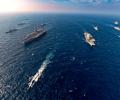
Remarks from Indian External Affairs are significant as it comes after China slammed Quad and said the formation of "exclusive cliques" targeting other countries runs counter to the trend of the times and is "doomed to fail".

Four frontline warships of the Indian Navy participated in the 'PASSEX' exercise when the US carrier strike group was transiting through the Indian Ocean Region on its way from the South China Sea, the officials said.

A number of other frontline ships, submarines and fighter jets of the three countries will be part of the over week-long drill in the Bay of Bengal which is taking place in the backdrop of a major military face-off between armies of India and China in the Sikkim section.
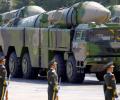
China is expanding its nuclear force and is likely to have a stockpile of about 1,500 warheads by 2035, up from the current estimated number of 400, the Pentagon has said in a report that notes that Beijing aims to expand its national power through both domestic and foreign policy initiatives.
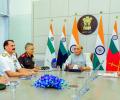
'Looking at how quickly the hostilities were escalating, the nuclear threshold did not seem that far.'

'India should not be taken by surprise if the Biden administration seeks China's cooperation at some point,' alerts Ambassador M K Bhadrakumar.
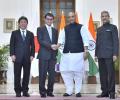
The India-Japan 2+2 dialogue added strategic heft to the special relationship in the wake of growing Chinese assertiveness on regional affairs, points out Dr Rajaram Panda.

India's decision to heed to Australia's request to be part of the mega naval drill comes in the midst of growing strain in ties with China over the border row in eastern Ladakh.
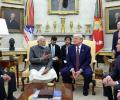
India and the United States have agreed to deepen their strategic partnership in several key areas, with President Donald Trump announcing plans to provide India with F-35 fighter jets and billions of dollars in military supplies. The two leaders also discussed energy cooperation, critical technologies, connectivity, and countering terrorism. They agreed to work together on the India-Middle East-Europe Economic Corridor, and Trump noted India's reforms to welcome US nuclear technologies. Prime Minister Modi said the two countries can shape a better world through their cooperation. Both leaders also addressed the Russia-Ukraine conflict, with Modi stressing India's commitment to peace.
